


What It's Really Like Working on a River Cruise Ship: My 8-Year Story
Every week I receive messages from people asking what life on a river cruise ship is really like. After spending almost eight years on board, I finally decided to write it all down. This isn't a recruitment pitch. It's simply my personal story—the good, the bad, and everything in between.
It was 2016, and I was working as a manager in a restaurant in Brno. Well... "restaurant" might be a generous description. It was more of a pub, if we're being honest.
Around that time, my long-time friend Katka returned from Greece. After a few months back home, she was already fed up with the routine, the constant complaining, and what she called the "typical Czech mentality." She kept trying to convince me to leave everything behind and go work abroad with her.
Being an adventurer at heart, I eventually gave in.
We started looking for jobs all over Europe until Katka found an advertisement looking for crew members on a river cruise ship.
Working on a ship?
That sounded like a proper adventure.
A few weeks later, after an interview with a recruitment agency, we received an offer. We accepted immediately. A couple of days later, we were sitting on a FlixBus heading to Germany.
The funny thing is that we didn't really know where we were going.
When we finally arrived, the ship literally slowed down next to a bridge, someone grabbed our luggage, and we jumped on board.
And just like that, it all began.
Our first surprise was the cabin.
Tiny.
Shared.
And located directly above the engines.
Whenever the ship was sailing, the vibrations were so strong that our teeth would practically rattle.
The second surprise came the next morning.
As a restaurant manager, I thought I knew quite a lot about hospitality. As a graduate of a language-focused high school, I was also convinced that my language skills were more than good enough.
I was wrong on both counts.
What followed was a brutal crash course in hospitality, teamwork, and how a restaurant actually operates when running at full speed.
We spent our days cruising along the Rhine and Moselle rivers. Back then, these were classic all-inclusive river cruises. Guests had full board, unlimited drinks, winery visits, and plenty of opportunities to enjoy themselves.
Let's just say we had around a hundred Danish guests on board, and they did absolutely nothing to challenge the stereotypes.
Life quickly settled into a routine.
Breakfast service.
Clean-up.
Refill the buffet.
Vacuum the restaurant.
Set up for lunch.
Look at the clock.
One hour until service starts again.
What?!
Quick lunch.
Quick bathroom break.
Change the sweat-soaked shirt.
Back to the restaurant.
After lunch?
Do it all again.
Set up for dinner.
Vacuum.
And then spend ten minutes looking for the vacuum cleaner because someone had inevitably moved it.
By the time dinner preparations were finished, we would finally dock somewhere.
And then came the daily dilemma.
Do I go explore the city?
Or do I go to sleep?
Most of the time, sleep won.
I would collapse into my bunk, set an alarm, and fall asleep almost instantly. My legs felt like concrete.
Then the alarm would go off.
Stand-by in thirty minutes.
Back to work.
Dinner service was just as intense. Four-course menus, endless trays of coffee, and guests who somehow always wanted one more thing before heading to bed.
Eventually the last guests would leave, and we could finally start setting up for breakfast.
At least in theory.
One evening I was completely exhausted and running around the restaurant like a headless chicken.
The kitchen had already finished.
Even the dishwasher had gone home.
Yet I was still there trying to figure out where to start.
That's when Dušan, a veteran crew member from Slovakia, looked at me and said:
"Vojtík, at this pace you'll still be here at sunrise. Come here, I'll show you how it's done."
Within twenty minutes we were finished.
That was the day I learned one of the most important lessons of my career:
Hard work matters.
But systems matter even more.
That evening we were docked in a beautiful town on the Rhine.
It was a warm summer night.
Katka wanted to go out for a while.
I needed cigarettes.
We left the ship and joined a few crew members for what was supposed to be one drink.
You can probably guess what happened next.
Cut.
It's 4 a.m.
We're stumbling back to the ship.
My alarm is set for 5:30.
I fall asleep before my head even touches the pillow.
And somehow, we did it all again the next day.
And the day after that.
And the day after that.
The amount of experiences packed into a single week on board was unbelievable. New people, new places, new languages, new challenges.
Life moved at a speed I had never experienced before.
The after-work parties gradually became part of everyday life.
Looking back now, I'm honestly surprised I survived those first six weeks.
Because after six weeks, I quit.
At the time, those six weeks felt like six years.
But there was one thing I couldn't deny.
In those six weeks, I learned more about hospitality, service, teamwork, and communication than I had learned during years of working in various restaurants back home.
My English improved dramatically.
My confidence improved.
And I grew up fast.
After leaving the ship, I spent a year working for BMW in Germany.
The job was fine.
The pay was fine.
But after life on a ship, it felt incredibly boring.
Every day looked exactly the same.
Then one day Katka called me.
By that point she had found herself a boyfriend.
On the ship, of course.
She asked me:
"Do you want to come to Amsterdam?"
I didn't need much convincing.
And this time, everything was different.
The ship was a Boat & Bike cruise.
Guests only had half-board. Every morning after breakfast, they would leave with a tour guide and spend the day cycling through the Dutch countryside.
The moment the last guest stepped off the ship, we started sailing.
Only three or four hours per day.
Never during the night.
Guests returned in the afternoon for coffee and cake, and in the evening we served dinner.
No all-inclusive packages.
No endless drinks.
No chaos.
Compared to my first ship, there was probably only a quarter of the workload.
Even better, I had my own cabin.
For anyone who has ever shared a cabin above the engines, that felt like winning the lottery.
This time I worked in the bar instead of the restaurant.
I stayed for the entire season.
And honestly, it was one of the best years of my life.
Suddenly, there was enough time and energy to explore.
Every day we woke up somewhere new.
Amsterdam.
Utrecht.
Gouda.
Rotterdam.
The IJsselmeer.
We used the company bikes to explore the towns and countryside whenever we had the chance.
We went to parties.
Tried new restaurants.
Spent countless evenings on the back deck with the crew.
At one point we even bought a giant inflatable pool and placed it on the sundeck.
Whenever the water supply boat arrived, we'd fill it up and spend hot summer afternoons splashing around on top of the ship like oversized children.
Every Wednesday we organised a crew barbecue.
Cold beers.
Good food.
Music.
Sunsets.
And a swimming pool on the roof of a river cruise ship.
Life was good. But what I remember most aren't the places.
It's the people. The friendships I built during that season are still some of the strongest friendships I have today.
The following season, I managed to get promoted to receptionist.
Later, I became a hotel manager.
For me, that was a dream come true.
A bigger cabin.
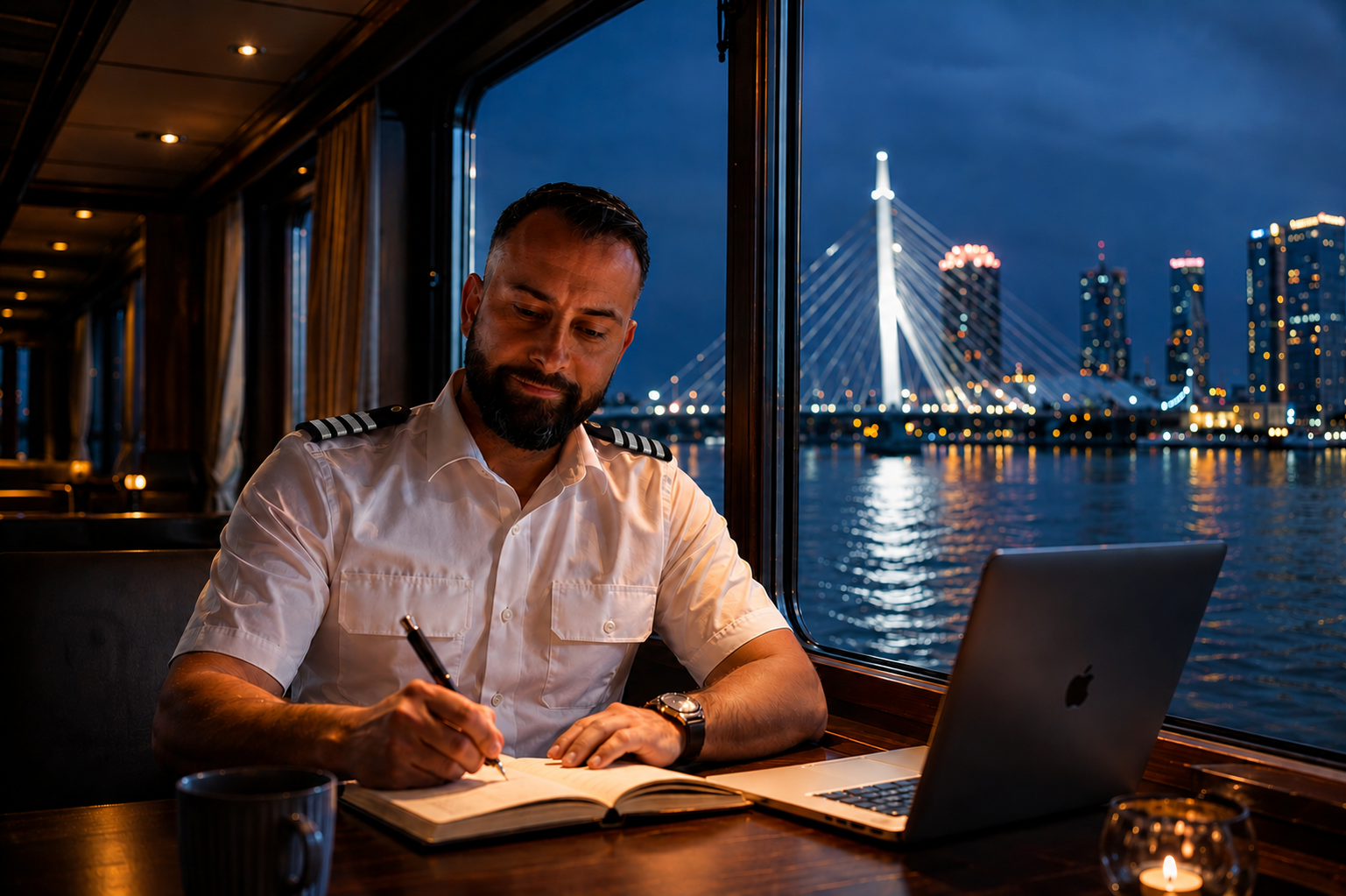
Four silver stripes on my shoulders.
A very sharp uniform.
Let's just say the uniform seemed to work better than any pickup line I'd ever tried.
And then I stayed.
For another four or five years.
The ships became my home. The rivers became familiar. The crew became family.
And even though I've long since hung up the stripes, I can honestly say that those years were both the hardest and the most rewarding years of my professional life.
Real Talk
Alright.
We've gone through my personal story, a few crazy memories from life on board, and hopefully I've managed to put at least a small smile on your face.
Now it's time for the real talk.
Let's put the romantic side of river cruising aside for a moment and talk about what the job is actually like. Let's talk about money, working hours, accommodation, crew life, and what you can realistically expect if you decide to work on a ship.
One thing is important to me.
I didn't start NorthPeak Staffing to send as many people abroad as possible and collect a commission. If that was my goal, I could simply tell everyone what they want to hear and conveniently leave out the difficult parts.
That has never been my approach.
My goal is simple: I want people to leave with realistic expectations and come back with a positive experience. Not only financially, but also with new skills, friendships, confidence, and memories that will stay with them for years.
So let's talk about things as they really are.
Salary
At the time of writing this article (2026), the standard salary on most Boat & Bike vessels is around €1,900 net per month.
For most hotel positions, the salary is the same regardless of whether you're working as a housekeeper, waiter, or bartender.
Chefs and management positions naturally earn more.
Personally, I see both advantages and disadvantages to this system.
On one hand, it creates a certain sense of equality within the crew.
On the other hand, a bartender who speaks several languages and is working their third season might earn exactly the same salary as someone doing their very first season.
Whether that's fair or not is up to you to decide.
The good news is that there is usually room for communication. If you have experience and can demonstrate your value, there's nothing wrong with having a conversation with the office or employer.
The worst they can say is no.
Tips
This is where things start getting interesting.
At the end of every cruise, guests are encouraged to leave gratuities for the crew.
The recommended amount is usually around €5 per guest per day, although the final amount depends entirely on the guests.
The tips are then distributed between the hotel department, nautical crew, and tour guides according to the company's rules.
Several factors influence how much you receive:
* Number of guests on board
* Occupancy rate
* Size of the crew
* Generosity of the passengers
* Number of tour guides on that particular cruise
From my experience, crew members typically receive somewhere between €120 and €200 per week in tips.
One thing I always liked is that tips are usually distributed very equally.
A housekeeper receives the same amount as the captain.
Not many industries work like that.
Travel reimbursement
The company offers travel cost reimbursement up to €200 per one-way trip, which applies during the season or after the successful completion of the season. You cover the cost from your own money, keep all the receipts and invoices for plane tickets, train tickets, and such, and once you’re successfully on board, you ask your HM for a form to fill out, and together with the scan or copies of the receipts and invoices, it's forwarded to the office. Normally, the reimbursement comes to your account of choice in a week.
Working Hours & Schedule
This is probably the section most people are interested in.
The first thing you need to understand is this:
The show must go on.
A ship is basically a floating hotel, restaurant, bar, and transportation service all at the same time.
Guests don't really care whether somebody called in sick, whether the dishwasher broke down, or whether half the crew had a rough night.
The operation has to keep running.
In most cases, you work six days per week.
How your time off is structured depends on many factors.
Sometimes you'll get a full day off.
Sometimes two half days.
Sometimes several shorter breaks throughout the week.
And occasionally, during busy periods, you may get less time off than you'd like.
Everything depends on:
* The size of the ship
* Number of guests
* Current workload
* Available staff
* Operational requirements
It's very difficult to guarantee exactly how every week will look.
Ultimately, the ship manager has the final say because they are responsible for making sure everything runs smoothly.
And trust me, that's not always an easy job.
Another important thing to understand is that people help each other.
Quite often you'll be asked to assist another department when needed.
A waiter might help with luggage.
A receptionist might help with housekeeping.
A bartender might help during embarkation.
That's simply part of ship life.
If you're not willing to be flexible and support the team when needed, this probably isn't the right environment for you.
Ships are built on teamwork.
The people who succeed are usually the ones who understand that.
Accommodation
One of the questions I get asked most often is:
"What are the cabins actually like?"
The answer is simple.
They're small.
Space is valuable on a ship, so don't expect a luxury apartment.
Some vessels have shared cabins, while others offer single cabins. It all depends on the size of the ship and the number of crew cabins available.
Every cabin has its own bathroom with a shower and toilet.
If you're sharing a cabin, you'll also be sharing the bathroom with your cabin mate.
If you have a single cabin, it's all yours.
Unless you're a couple, cabins are generally assigned to crew members of the same gender.
Air conditioning is standard and, during my eight years on board, I never had any serious issues with it.
Storage space is surprisingly good. You'll usually have a wardrobe, drawers, storage under the bed, and enough room for everything you actually need.
The internet is available on board and is free for both guests and crew. The quality naturally depends on where the ship is located, but overall it's usually quite reliable.
If you've never lived in a small cabin with another person before, it can be a bit of a shock at first.
How Does the Ship Actually Travel?
Many people have no idea how river cruise ships operate.
On Boat & Bike vessels, the ship usually sails during the day and only covers relatively short distances.
After breakfast, the guests leave on their bicycles with a tour guide while the ship slowly makes its way to the next destination.
By the time the guests arrive in the afternoon, the ship is already waiting for them.
Traditional river cruise ships operate differently.
They often sail during the night, meaning guests can go to bed in one city and wake up in another.
Sometimes even in another country.
Crew Meals
Food is provided free of charge and there's plenty of it.
Crew members receive breakfast, lunch, and dinner every day.
Breakfast is the same what the guests receive, including bread, eggs, fruit, yoghurt, and other buffet items.
Lunch and dinner are usually prepared separately for the crew.
That makes sense because guest menus repeats every week according to the cruise itinerary and the crew would quickly get tired of eating the same meals week after week.
Most chefs make a genuine effort to keep crew meals varied and interesting.
In my experience, the food was generally very good.
There was always enough fruit, vegetables, and fresh ingredients.
Crew Nationalities
When I started working on ships almost a decade ago, the crews were made up mostly of Czechs and Slovaks.
Today things are much more international.
You'll still meet plenty of Czechs and Slovaks, but also Romanians, Hungarians, Serbians, Croatians, Bulgarians, and many other nationalities.
River cruising has become a truly international industry.
The official language on board is English.
German is a huge advantage, especially if you're working in the restaurant, bar, or reception where guest interaction is a major part of the job.
Friendships and Relationships
When people work together, live together, eat together, and spend months on the same ship, strong friendships naturally develop.
Many of the people I met years ago on board are still among my closest friends today.
Sometimes, only half jokingly, I compare ship friendships to the friendships soldiers describe from military service.
When you go through long shifts, difficult days, celebrations, mistakes, adventures, and unforgettable experiences together, people become incredibly close.
And yes.
Relationships happen too.
Much more often than you might think.
What Type of Person Succeeds on Ships?
From my experience, the people who do best are:
* Flexible
* Team-oriented
* Sociable
* Adventurous
* Open to learning new things
People who may struggle are:
* Those who need a lot of personal space
* People who dislike change
* Individuals who don't enjoy teamwork
* Highly confrontational personalities
A ship is a small community.
You don't finish work, drive home, and start fresh the next morning.
You live together.
That means your attitude and ability to get along with people are often just as important as your professional skills.
Would I do it all again?
Without hesitation.
Not because it was easy.
Not because I made a fortune.
And certainly not because I enjoyed cleaning a restaurant at midnight after a fourteen-hour day.
I would do it again because those years changed me.
They taught me resilience, teamwork, leadership, communication, and confidence.
They introduced me to some of my best friends.
They showed me places I would never have seen otherwise.
And they gave me memories that still make me smile years later.
River cruise ships are not for everyone.
But for the right person, they can become much more than just a job.
They can become an adventure.